

You are welcome to republish this story through the Creative Commons license CC BY-NC-SA 4.0. Where republishing conditions differ for images, this is noted in individual captions. (See this page for more information.)

By Eileen Crist
Eileen is recently retired from Virginia Tech, where she taught for 22 years. Her writing focuses on Life’s crisis, its root causes, and pathways towards an ecological civilization.
Encountering a wild animal in its natural habitat is a great privilege as it brings us into contact with the quality of awareness the animal exudes. The etymology of animal derives from “anima,” meaning breath, vitality, soul. Animals animate the world; they ignite landscapes with awareness and with the unpredictability of awareness.
Once when I was snorkeling in the British Virgin Islands, I followed a stingray (something I tend to do when I encounter one) mesmerized by the beauty of his sand-colored form and flowing movement. He swam ahead of me a meter or two with a mix of wariness and indifference. Suddenly, as though he’d had enough, he made a 180-turn, settled on the sand with a huff, and stared me down. I took the hint and nonchalantly swam off in another direction.
Another time, I took a big gulp of air and dove down to peer into a coral reef crevice. I was delighted to come face to face with a lobster and to experience again the jolt of eye contact—spooky action at a distance joining two beings momentarily within a shared field of intimate awareness. The lobster waved his big claw at me, attempting to look dangerous; that’s when I saw, just behind him, his mate peering at me with her question-mark eyes. It was so brief a moment, as water and want of air were pressing me upward. But that moment imparted an unforgettable experience of… Of what? Of too much for words. That’s this planet. So many words we find to speak about it and speak for it, yet Earth overflows with a presence that words can barely touch.
Every time I’ve snorkeled, I always hoped to see a sea turtle. I have a love for them that’s as special as the love I have for all animals, special in its own special kind of way. So, every time I put on my snorkeling gear, I always made a wish (or, I should say, the wish always arose within me) to see a sea turtle. The one time I got my wish was when I forgot to make it. I just jumped in the water and there she was, unusually big for the Anthropocene, some three quarters of a meter head to tail. I could hardly believe my eyes. I swam above her as she continued flying unhurriedly, only latching her doleful eyes into mine—like she recognized me. Then I saw a silver metal band notched on one of her flippers. And the sadness in her eyes met the sadness in my heart.
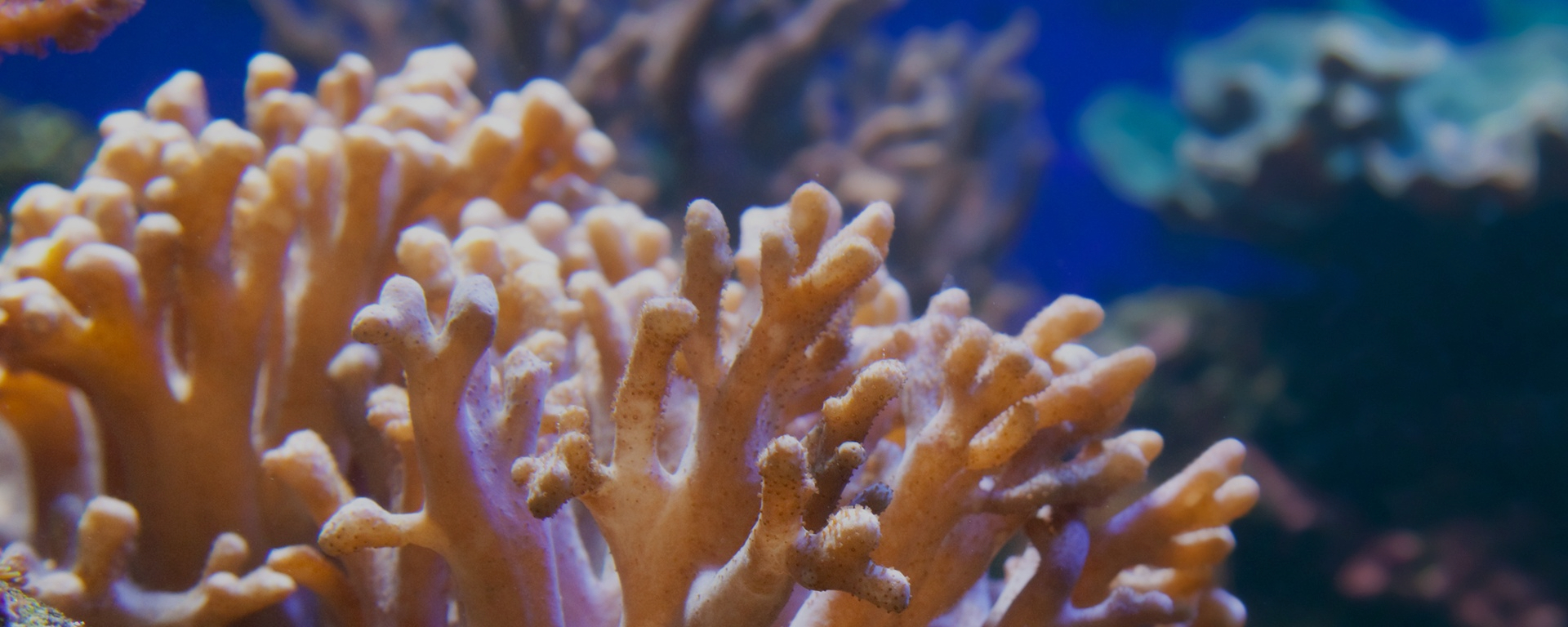
This place in the Caribbean was once thriving with coral reefs. Its present-day dilapidated state of sick and dead coral and hardly any fish (as of my last visit in 2025) reflects the condition of these ecosystems worldwide. Already half of the world’s coral reefs are gone, and coral reef scientists are not optimistic about the ones that remain. But there’s no doubt that we can still take a stand for coral reefs by taking action to rewild them.
The coral reefs of the Caribbean are in especially dire straits for a simple and uncontroversial reason: Among the numerous impacts that are devastating coral reef ecologies worldwide, they are subject to all of them: fishing, coastal development, sewage and sediment pollution, disease, boat anchors, tourism, and global warming. Generally, when people think about coral reef losses they gravitate to the last cause. But there’s a reason I put it last: Everywhere that coral reefs are “only” subjected to global warming, they are doing much better than where they are subjected to multiple threats—most especially fishing. Wherever coral reefs enjoy some level of protection, they are doing better than where they are not. Strict protection makes the greatest difference. To rewild coral reefs, therefore, we must remove the pressures that are ravaging their ecological vitality and allow them to self-repair.
From everything we’ve learned about our impact on coral reef ecosystems, we now understand that the pathway to rewilding them is to give them maximum freedom from human impingement so they may heal on their own terms. Of course we must work on slashing greenhouse emissions. But even if we were to stop all emissions tomorrow, the warming in the pipeline would still take its toll. Yet coral reefs may be able to negotiate and adapt to some warming, if we remove all other factors of their destruction. So, we give a chance to coral reefs to survive this time of endarkenment—of unfathomable ignorance about the beauty and magic and diverse forms of awareness that abound on Earth—by strictly protecting them. There are two forms of strict protection: No Take and No Entry. “No Entry” obviously includes “No Take,” but ups the ante by prohibiting boats, swimmers, and divers from visiting.
Coral reefs are not only breathtakingly beautiful, but they are also scientifically astonishing in many ways, two of which I will single out here: First, they defy the classic food-pyramid pattern of few apex predators at the top and many prey species at the bottom; in healthy coral reefs, unexpected abundances of sharks and other predators patrol the waters. Second, it is not clear that there is an upward limit to the numbers of species that a coral reef can support; according to reef expert Callum Roberts, given enough time, coral reefs might become increasingly richer as more species are added by evolution. Coral reef seascapes are characterized by immense architectural complexity, bewildering diversity of life, extraordinary adaptations, and remarkable longevity as life builds reefs upward and outward over centuries and millennia.
Coral reefs deserve the generosity and wisdom of No Take and No Entry. If we cannot imagine that coral reefs deserve our generosity and wisdom because they do, perhaps we can imagine a future time of an enlightened humanity—that we keep steadfast faith with—that knows the true value of what wild Earth creates: A value we encounter, a value for which no measure is known.
Sources
Clover C (2022) Rewilding the Seas: How to save our oceans. Witness Books.
Roberts C (2020) Reef Life: An underwater memoir. Pegasus books.
Sala E (2015) Pristine Seas: Journeys to the ocean’s last wild places. National Geographic.
Walker P and Wood E (2005) The Coral Reef. Facts On File, Inc.
 Rewilding Successes