

You are welcome to republish this story through the Creative Commons license CC BY-NC-SA 4.0. Where republishing conditions differ for images, this is noted in individual captions. (See this page for more information.)
By Isabella Clarke
Isabella is an independent researcher.
“We have nine different species of bat here,” says Merlin Hanbury-Tenison as we walk through the wooded valley on Cabilla, his family farm in Cornwall, England. “Including rare greater horseshoe bats.”
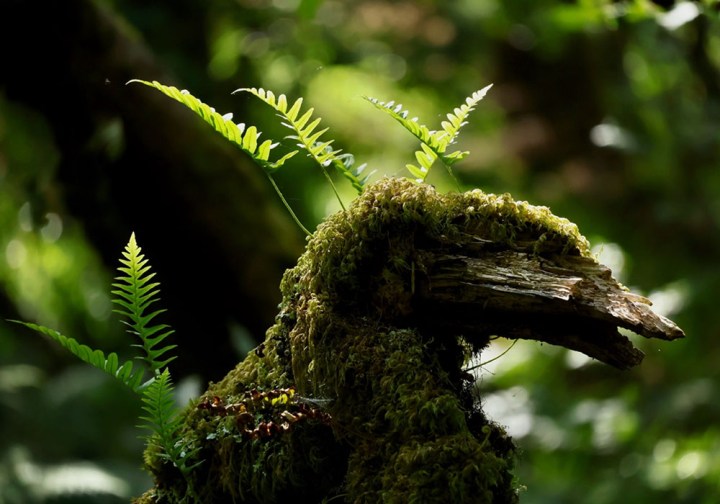
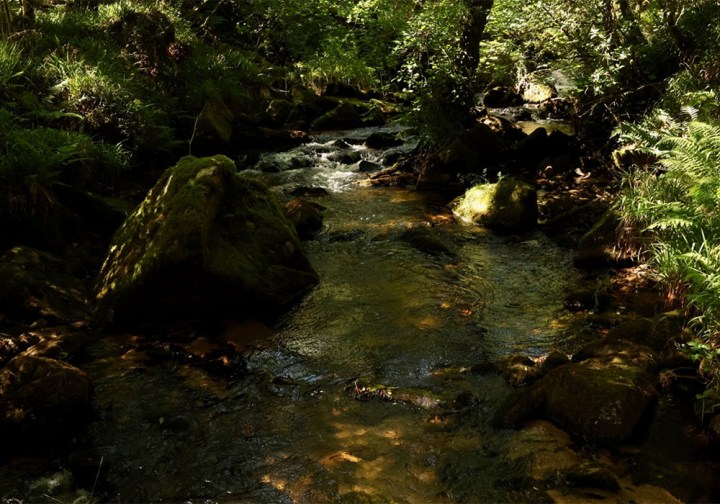
The woodland is temperate rainforest, a globally rare habitat (just 1% of land cover). In the UK, as much as 20% of the land may have been temperate rainforest in the relatively recent past; only 1% of that total remains. This habitat requires conditions so wet and mild that plants grow on other plants. Branches are draped in mosses, liverworts, lichens, ferns, and even tree saplings—affectionately known as “air trees”. The biodiversity is astounding.
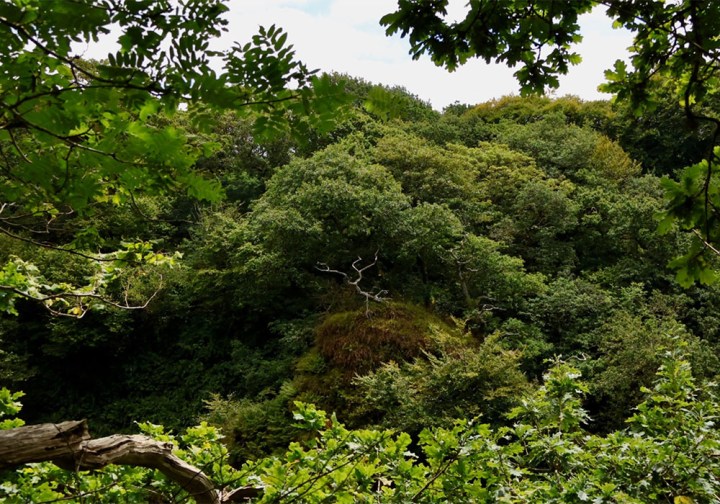
Cabilla’s rainforest comprises about a hundred acres on the south-western edge of Bodmin Moor in Cornwall. Merlin’s father, the explorer Robin Hanbury-Tenison, bought the property in the 1960s. For Merlin, this was his playground as a child and his refuge when he returned from military service in Afghanistan. It has become the focus of his considerable energy and impressive ability.
In the last decade, Merlin and his wife Lizzie have established both a retreat centre and a charity. The retreat centre is a business, but Merlin emphasises that the health of the rainforest remains sacrosanct: nothing will be allowed to damage its vitality. Instead, his priority is to restore the wild wood as the wild wood restores humans.
This is the work of a charity called the Thousand Year Trust, which has a wider focus than just Cabilla’s rainforest. The charity may have started as a bid to triple the rainforest acreage on the family’s land, but now, with the formation of the Cornwall Rainforest Project, it seeks to triple the UK’s total temperate rainforest coverage.
To understand how best to enable temperate rainforest to expand and regenerate, the Trust engages in partnerships with organisations such as the Wildlife Trusts and the Woodland Trust, as well as with academics and researchers from the Eden Project, the University of Plymouth, and the University of Exeter. They have plans in place to build the country’s first Rainforest Research Centre at Cabilla.
Ahead of that ambitious project, researchers have already established that there has been continuous tree cover on the site for more than 3500 years. Undergraduate and postgraduate students have written research theses on, for example, the soil, the invertebrates, the mycorrhizal fungal diversity, the lichen, and the ecological impact of a family of rewilded beavers.
As beavers restore the willow carr in the valley, humans are working higher up the hillsides. The Trust has planted thousands of trees, not just oaks, but also the pioneer species, rowan, hazel, alder, and willow. As yet, this is just a fraction of the 100,000 total that is the aim, half of which are expected to come through natural regeneration. And, in a non-ideal world, natural regeneration often requires human assistance.
Merlin explains that there are precious few oaks less than 200 years old in the rainforest. In an area without apex predators like wolves, lynxes, or bears, but with many roe and red deer, plant regeneration fails to occur. Now that the temperate rainforest is the centre of scientific activity, active protection, and a retreat business, the deer are “being controlled,” as Merlin suggested. He shoots them. He also butchers them to feed his family.
Killing deer is an act I recoil from. And yet, when I consider a nature reserve where I volunteer, home to many muntjacs, I can understand. There’s precious little ground flora, which adversely impacts invertebrates and consequently the birds, small mammals, and other creatures who rely upon them. Putting the woodland as a community of plant and animal beings into the ethical foreground shifts the perspective.
This is another area where the non-ideal nature of the world appears to demand non-ideal action, or, at least, to demand that we recognise that hard decisions have to be made, and that there will always be someone—deer, chicken, oak seedling—who suffers from those decisions.
Furthermore, both planting trees and killing deer can be seen as activities in which humans engage in the “becoming of the woodland” as entangled members of a multispecies community striving not simply to survive but, more importantly, to assist in generating a place more habitable for all. In Merlin’s words, “The most important, hopeful and positive endeavour that any of us can embark upon is to ease our transition to a society that lives as a part of Nature, not apart from Nature.”
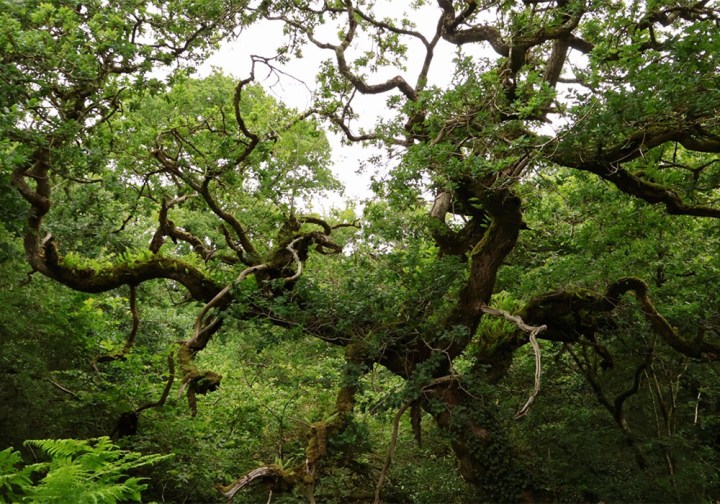
That is the ethic that has inspired him, absorbed from spending long hours under the oak he calls the Mother Tree. He imagines her children growing under the protective stems of hawthorn, where jays have forgotten an acorn cache, and the connective mycelial filaments linking her to them, spreading through the millennia-old woodland soil. He imagines those seedlings coiling into the green light of the rainforest, blanketed by bryophytes and lichens, becoming a habitat for ferns and, perhaps, as in the arching branches of the Mother Tree herself, a young rowan. He imagines the humans of the future resting in enchanted wonder, soothed by the dappled shade of shimmering leaves, just as he, his parents, Lizzie, and their two young daughters do today.
 Rewilding Successes