

You are welcome to republish this story through the Creative Commons license CC BY-NC-SA 4.0. Where republishing conditions differ for images, this is noted in individual captions. (See this page for more information.)
By Joe Gray
Joe is editor-in-chief of Rewilding Successes.
Northern Spain is home to a number of species of animal whose presence might, to the uninformed, come as something of a surprise. Here, across the upper band of the Iberian Peninsula, grey wolves still roam in numbers, while brown bears are beginning to rebound. And, in the far north-east, within the autonomous community of Catalonia, a European tortoise is being bolstered through a long-term series of reintroductions.
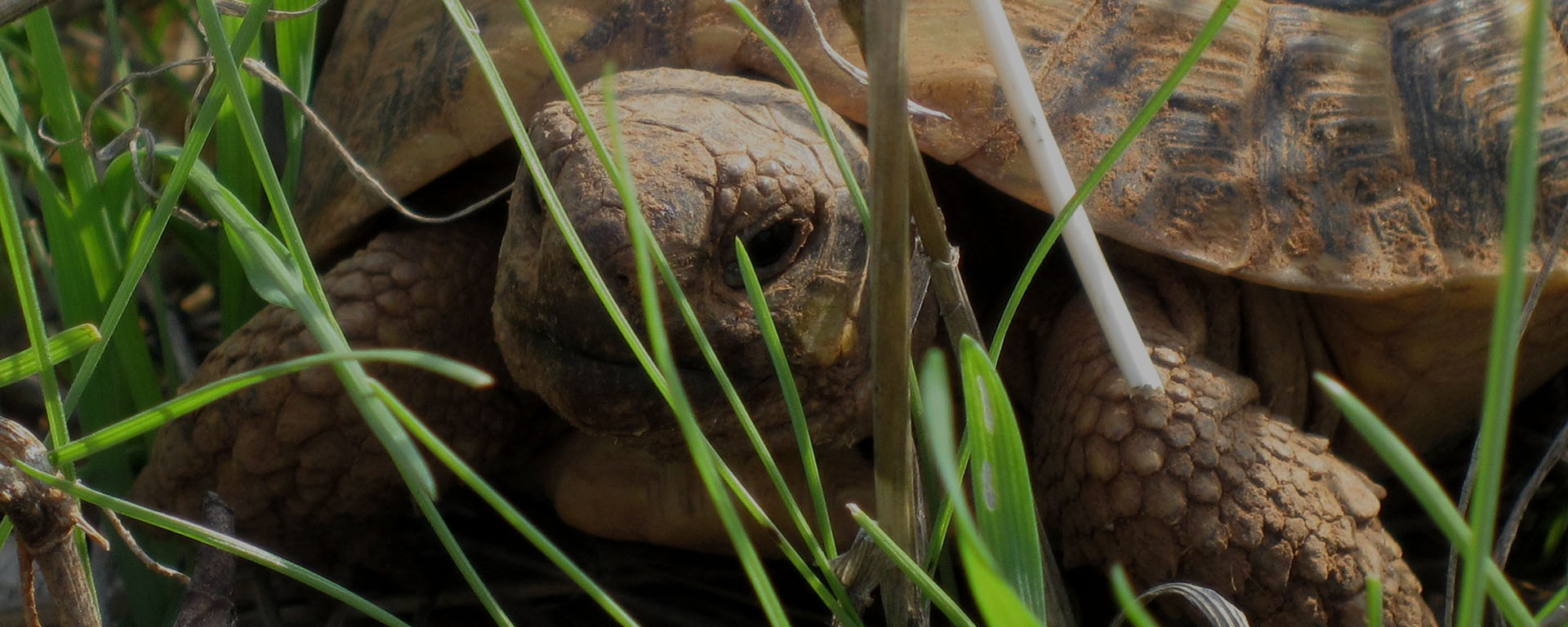
Hermann’s tortoise (Testudo hermanni), known as la tortuga mediterrània in Catalan, is north-east Spain’s only native tortoise.1 A species of dry or semi-humid habitat from sea level up into the hills, this animal favours habitat with limited tree cover and good feeding grounds, such as grassy meadows.
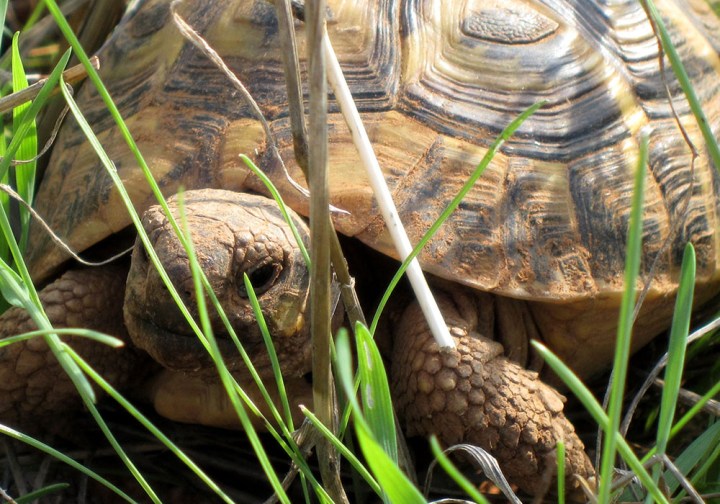
Like other members of their family—but unusually for reptiles—Hermann’s tortoises are predominantly, if not exclusively, vegetarian. And they are perceived by humans to lead tranquil lives. However, male combat around courtship opportunities can be vigorous, with the noise of carapace clashing against carapace being audible from a considerable distance.
Sadly, Hermann’s tortoise is a species with an all-too familiar story of decline. Once present up and down the coastal margin of Catalonia, this reptile’s wild footprint in Iberia has been reduced to a mere 130 km2—in the Albera mountain range near the border with France. Causes of the decline include: loss and fragmentation of suitable habitat, through the incursions of modern agriculture (including viniculture and pastureland); traffic-related deaths; the increasing hazard of fire; and poaching for possession or sale as pets.
However, there is an unusual twist to the tale. For in that last causative factor—poaching—lie the seeds for a solution. Hermann’s tortoises can live for a long time (reportedly, up to a century or more), and so animals who have been removed from the wild in years or decades past might today be directly returned through sanctioned releases or cared for at conservation breeding centres. In the fight to save life on Earth as we know it, there is never a simple “undo” option for truly reversing past misdeeds, but this is a case that comes reasonably close to such a possibility.
One conservation breeding facility—el Centre de Reproducció de Tortugues de l’Albera, located just outside the small Catalonian town of Garriguella—recently celebrated its fortieth anniversary. During this time, the centre has supplemented the surviving Albera population with close to 4000 tortoises, both through repatriation into the wild of poached individuals and releases of animals born under the facility’s care.
In addition, many more tortoises born at the centre in Garriguella have been introduced as part of initiatives to restore populations elsewhere in Catalonia, including in the Garraf and the Montsant mountain ranges. Reintroduction projects in those two areas began in 1993 and 2006, respectively.
Population restoration work is also ongoing in the Ebro delta (where it dates back to 1987), the mountains of Llaberia, the Cap de Creus, and elsewhere in Catalonia. Other conservation breeding facilities supporting the coordinated efforts include those run by el Centre de Recuperació d’Amfibis i Rèptils de Catalunya in the town of Masquefa. In 2024 alone, this organization was involved in the release of more than 1000 Hermann’s tortoises in Catalonia.
The reintroduction efforts have undoubtedly provided a sorely needed boost to the survival prospects of the tortoise in Iberia. But with continuing interventions being deemed necessary in a programme that is soon to enter its fifth decade, here is evidence of the level of commitment needed to heal a species in decline.
Location of Garriguella
Footnote
- The Field Guide to the Amphibians and Reptiles of Britain and Europe (Bloomsbury Publishing, 2018) suggests that the presence of Hermann’s tortoise in Catalonia may be the result of ancient introductions. ↩︎
 Rewilding Successes