

You are welcome to republish this story through the Creative Commons license CC BY-NC-SA 4.0. Where republishing conditions differ for images, this is noted in individual captions. (See this page for more information.)
By Joe Nash
Joe Nash is the Press and Stories Lead for Citizen Zoo.
The Hop of Hope project from Citizen Zoo ties into wider efforts to restore ecosystems, habitats, and biodiversity in the East of England. As well as bringing about a successful reintroduction of the large marsh grasshopper (Stethophyma grossum), a Hop of Hope is a demonstration of citizen science in action. Fostering a diverse community of grasshopper-rearing volunteers, the project has ensured that the UK’s largest native grasshopper has a firm place in the hearts of the local residents in the species’ reclaimed home.
Historically, the East of England had extensive wetlands and bogs, particularly in the Fens and Broads. Vast areas of wetland were drained from the 17th century onward for agriculture and industrial development, leading to the large-scale loss of wetland habitats. This has caused declines and disappearances of many endemic species, including the large marsh grasshopper.
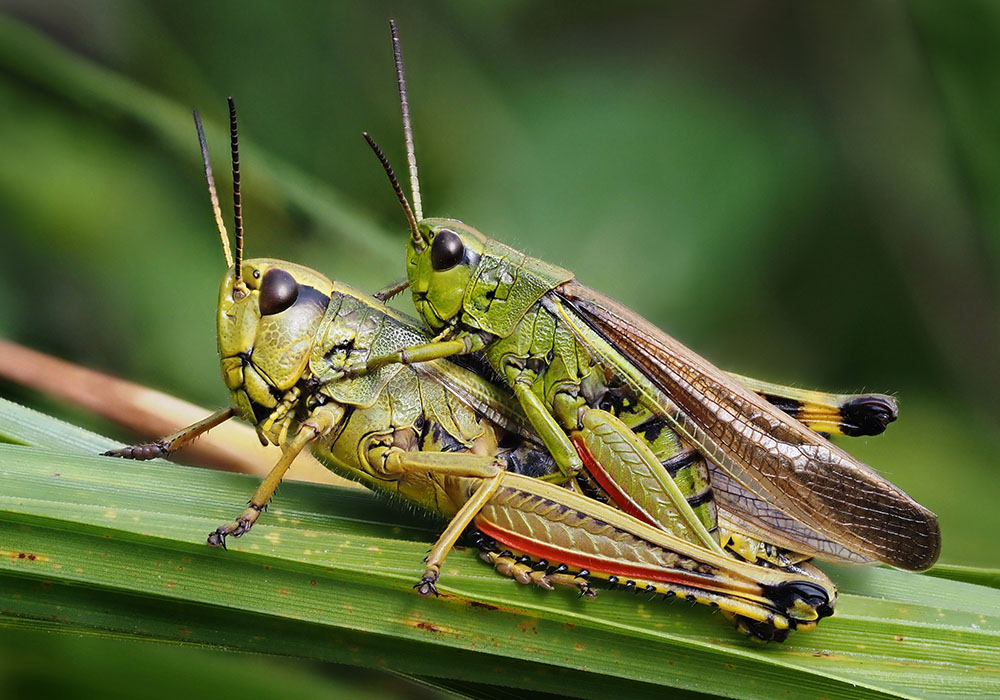
Prior to Citizen Zoo’s creation of the Hop of Hope project, the grasshoppers were surviving almost exclusively in the New Forest and Dorset. Through collaboration between the Norfolk Wildlife Trust, the Wildlife Trust for Bedfordshire, Cambridgeshire and Northamptonshire, the South Yare Wildlife Group, and Natural England, a handful of ecologically important and suitably managed sites across Norfolk were identified for the reintroduction of the species, including Wild Ken Hill and Wheatfen Nature Reserve.
It all began in 2018 with consent from Natural England and the Forestry Commission, after which Citizen Zoo safely collected a limited number of wild grasshoppers at several sites in the New Forest. Half were introduced directly at the project’s first wetland site in Norfolk. The rest were brought into captivity, to be bred in carefully controlled conditions under the expert guidance of the project’s lead entomologist, Dr Stuart Green. The resulting eggs were used in the project’s first volunteer-led captive breeding programme in 2019.

The volunteers, known as “Citizen Keepers,” were provided with a home terrarium and received training on how to care for the large marsh grasshopper. Each volunteer was given a clutch of ten egg pods, with each pod containing up to ten eggs, allowing for the potential rearing of 100 grasshoppers per volunteer. Once the eggs hatched, two release events were conducted on separate days during the summer. This methodology has been refined and repeated successfully each year since then.
Volunteers for the project represent a cross-section of society, from university students to retirees, families with young children, and even professional entomologists. A community of Citizen Keepers has flourished with the Hop of Hope project. Participants share photos, updates, and news on a project forum, bringing a diverse group of people together through their passion and enthusiasm for nature.
Insects and other invertebrates may not quite ignite the public imagination in the same way as more charismatic species like Eurasian lynx (Lynx lynx) or golden eagles (Aquila chrysaetos) do, but the story of the large marsh grasshopper reintroduction was picked up by the likes of Wired and the BBC, showing that no matter how small the animal, the return of nature is good news and can be enjoyed by everyone.
From a reintroduction point of view, the Hop of Hope project has been a success. Through the summer months, the sound of male grasshoppers calling out for mates fills the air of the project’s receptor sites. Since the initial release in 2018, over 6500 individual grasshoppers, reared at home by just 46 volunteers, have been released.
Across the main release sites, grasshopper populations are self-sustaining. We know this courtesy of the small dots with which captively bred individuals are marked before release, enabling the team to discriminate between these grasshoppers and those born in the wild. It’s hoped that the remainder of the sites all become a home for self-sustaining grasshopper populations in the coming years.
As part of the wider food web, the large marsh grasshopper provides a sizable meal for the various insect-eating birds in their new bog and wetland homes. Additionally, they have become a fairly common food source for labyrinth spiders (Agelena labyrinthica), whose funnel-like webs are often seen holding dead grasshoppers or their remains. Another of the grasshopper’s ecological roles is the breaking down of plant matter and recycling nutrients into the soil.
As is so often the case with rewilding, the aims are as much about safeguarding the future as they are about restoring pieces of the past. As climate change continues to wreak havoc on ecosystems around the world, the South of England is expected to see significant climatic changes over the next 50 years.
If the grasshoppers are to survive the coming effects of climate change, it is necessary for populations to expand out of their remnant pockets within Southern England and establish self-sustaining populations further north. The return of the large marsh grasshopper to its former ranges in the East of England is not only a small act of reparation for human-inflicted damage of the past, but also a lifeline for the species in the UK for the future.
 Rewilding Successes