

You are welcome to republish this story through the Creative Commons license CC BY-NC-SA 4.0. Where republishing conditions differ for images, this is noted in individual captions. (See this page for more information.)
By Rory Richardson
Rory is the manager of Creag Meagaidh National Nature Reserve.
NatureScot’s Creag Meagaidh National Nature Reserve (NNR) is a spectacular upland site covering nearly 4000 hectares and straddling the east and west Highlands of Scotland. A mosaic of habitats stretches from the shores of Loch Laggan to the high summit plateau.
Ecological restoration has changed the landscape of Creag Meagaidh over the last 35 years, and the reserve is now widely regarded as among the finest examples of natural woodland regeneration in Scotland. But it was not always so.
Since the last glacial period, the natural habitats of the Scottish Highlands have been influenced by both natural change and human activity. From the seventeenth century, timber exploitation increased, and, critically, this was followed by two centuries of land management based on maximum yields of deer, grouse or sheep. This in turn was associated with managed burning and overgrazing, which have prevented the natural regeneration of woodlands over the last hundred years in many parts of the Highlands.
Creag Meagaidh has been designated as a Site of Special Scientific Interest since 1964 for its geological features, and this status was enhanced in 1972 to recognise the importance of its habitats. By the mid-1980s, however, many of these habitats remained suppressed by high densities of red deer and sheep through grazing, browsing and trampling.
Around this time, a forestry company had purchased Creag Meagaidh and planned to plant the hillside with commercial non-native conifers like Sitka spruce. This alarmed conservationists, and, after government intervention, the land was sold to the Nature Conservancy Council (now NatureScot) and eventually became an NNR in 1986.
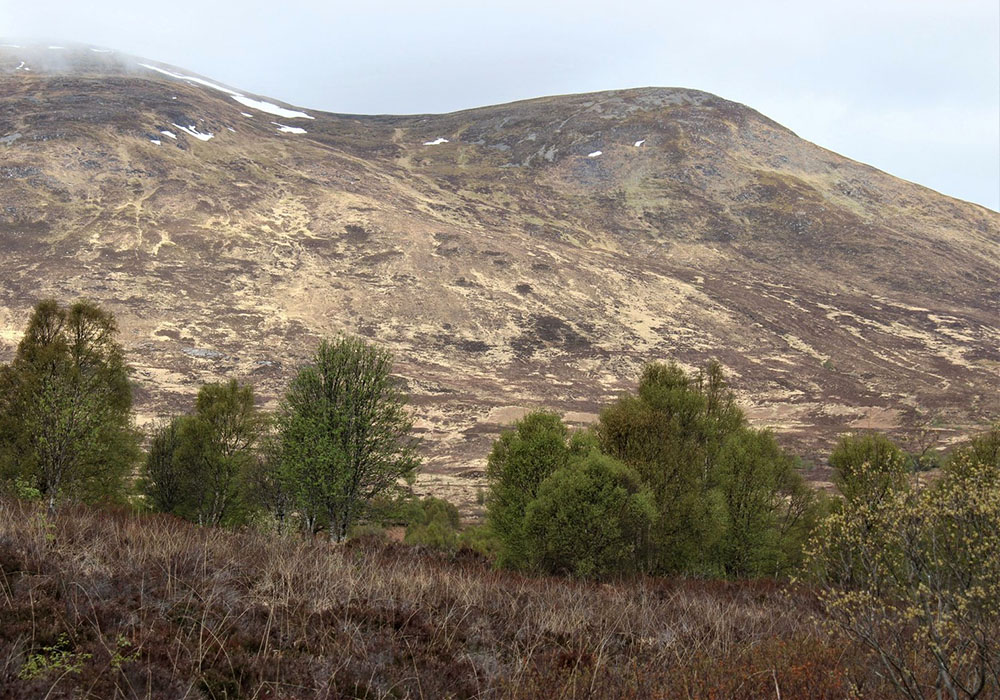
The first management plan for the NNR set the objectives of “allowing ecosystems to evolve with minimum interference” and “encouraging regeneration and extension of native forests.” The principle of ecological restoration with minimal intervention remains to this day.
Sheep were removed from Creag Meagaidh, and a huge effort has been put into restoring the balance in the ecosystem by managing wild deer to bring impacts down to a level which allows the remnants of native woodland to expand by natural regeneration.

The ambition from the early days of the NNR has been to achieve restoration without deer fences. This means that the woodlands remain open to wild deer, where—at low densities—they play an important natural role in shaping the development and structure of the habitats. Woodland provides shelter and food for deer, especially in winter, and it is hoped that in the future an increase in woodland cover in the area will result in better habitat for many wild animals, including deer.
Delivering the deer cull is a challenging operation, and one of the main activities of the team of staff employed at Creag Meagaidh. Deer management enables the reserve to supply venison, which is sold locally to provide a low-food-miles and sustainable food source. This programme was recently expanded through a new community stalking scheme, which allows local residents direct access to small quantities of venison.
Aside from some very small-scale experimental planting on the crags, the expansion of woodland at Creag Meagaidh has been entirely natural. This has resulted in a mix of habitats, with trees growing where they can, generally on the drier mineral soils, and bog and heath surviving in the wetter or more exposed areas, where trees struggle to grow. A small herd of Highland cattle graze grasslands and the woodland edge, as well as helping to improve degraded wet heath habitats.
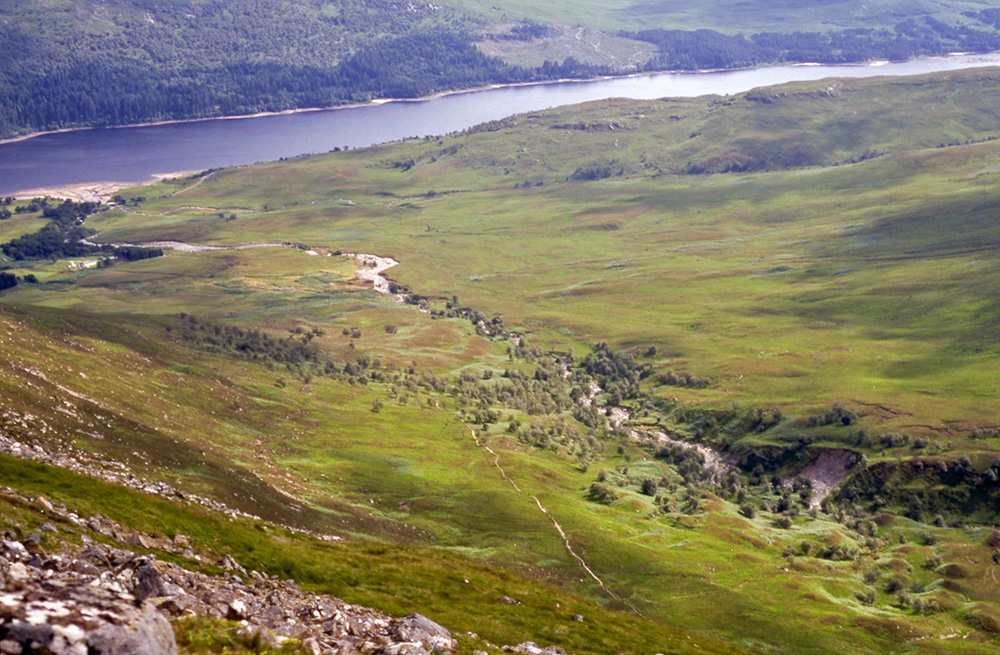
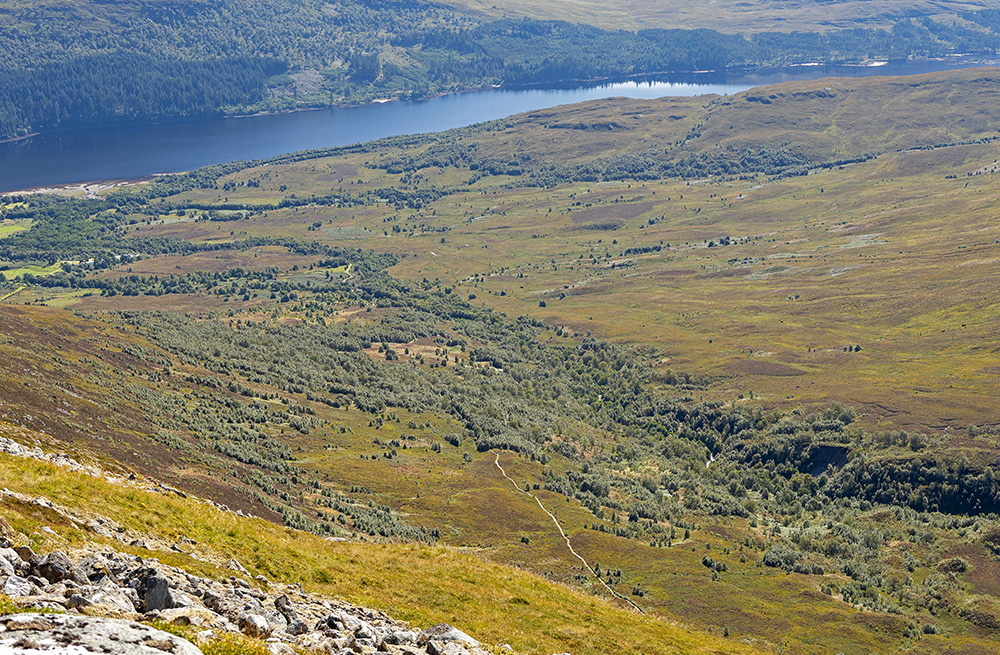
View of Creag Meagaidh NNR (left: 1994, © D Balharry; right: 2023, © NatureScot)
The rich tapestry of habitats supports a broad range of species, not least the spectacular black grouse, with more than 60 male birds lekking on the NNR in most years. These striking birds like a mix of maturing broadleaved woodland, an expanding natural regeneration zone with plenty of young trees, and patches of heath and bog along the woodland edge.
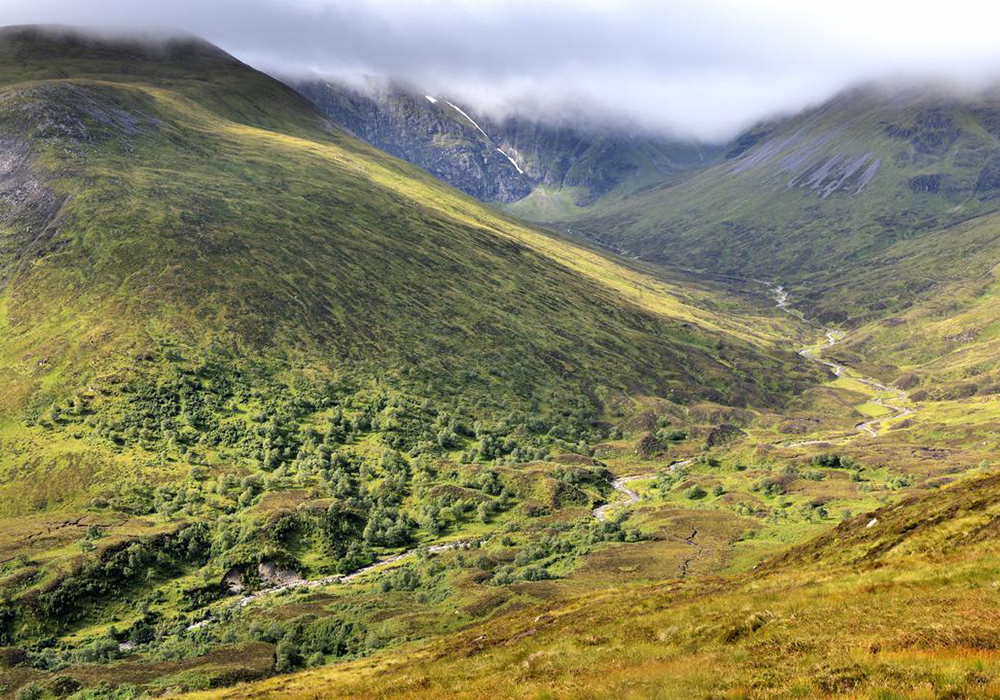
Visit Creag Meagaidh today and you will see a landscape transformed, with young trees creeping ever further up the mountain side as the woodland continues to recover and expand.
People are very important for the NNR, and our small team of staff works hard to encourage as wide a range of visitors as possible. A network of paths from the lower ground right up to the summits helps people to enjoy Creag Meagaidh’s woodlands, mountains and wildlife whatever their ability. The NNR is also a base for demonstration and training events for a wide range of rural skills, allowing future generations of rural workers to gain qualifications, skills and experience.
 Rewilding Successes