


You are welcome to republish this story through the Creative Commons license CC BY-NC-SA 4.0. Where republishing conditions differ for images, this is noted in individual captions. (See this page for more information.)
By Erica Nathan
Erica is a member of a small Bushcare group working to restore grassy woodland in the Hobart area of Tasmania, Australia. She writes with an academic background in environmental history and a dirt-under-fingernails interest in conservation endeavors.
Hobart, Tasmania, is a small city recessed into nearby river and mountain. At its urban edge is the Domain—some two hundred hectares that, in colonial times, served as grazing paddock for Government House. Walking from the centre of the city, or from the harbour’s edge, it takes ten minutes to reach the Domain’s southern boundary, a further thirty minutes to get to the summit, and perhaps another ten to reach the northern point. As a landform, it rises from the city’s river estuary in a gradual upsweep, with its summit more a rounded knoll than a peak.
The Domain’s recent history is recognizable far and wide. There was violent interruption and cessation of indigenous ways—firing, harvesting, and hunting—as lived by the Muwinina people, and currently valued by their descendants. Invasion records described it as grassy woodland—that is, well-spaced eucalypts (Eucalyptus pulchella, globulus, and viminalis) and underneath them a flourishing of kangaroo grass (Themeda triandra).
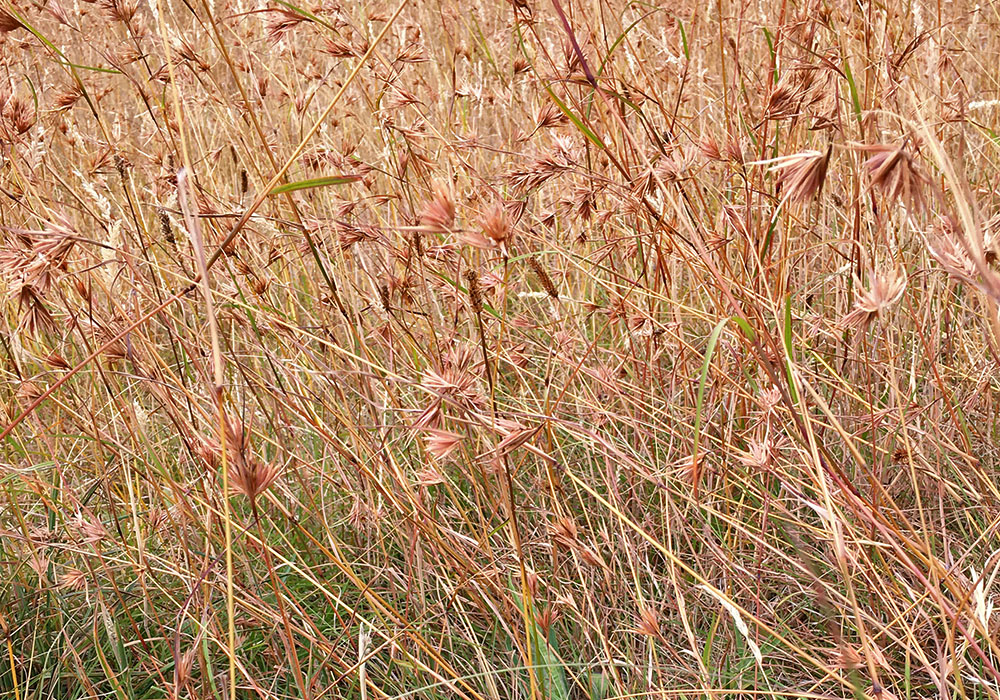
As Hobart evolved, the grassy woodland diminished. Livestock grazing, timber harvesting, municipal rubbish dumping, and quarrying were followed by excisions for cricket ovals, botanical gardens, swimming pools, the connecting of roadways, and a small zoo that held the last Tasmanian tiger in captivity.
This tenacious parcel of land is many things—not quite bushland, or parkland, or sports area; more a historical mishmash of vegetation that, surprisingly, still retains a sense of its former whole as grassy woodland. The Domain is managed by local government with limited resources. There is an intent to conceptualize it as one entity, but the reality is a more siloed approach based on staffing divisions for Sports and Recreation, Parks and Gardens, and Fire and Biodiversity.
This mixed-up place is also my backyard. Twice a day, for some fifteen years, I have opened the back gate to traverse its myriad tracks. I volunteer with a Bushcare group that helps with weeding and planting. My garden is designed to reach out to the Domain, providing a bridge of local plants for feathered and furred creatures.
Complexities of ecological restoration
When hundreds of trees were cut down on the Domain, my initial instinct was toward protection and defence. Allocasuarina verticillata, also known as the drooping casuarina or she-oak, was the target.
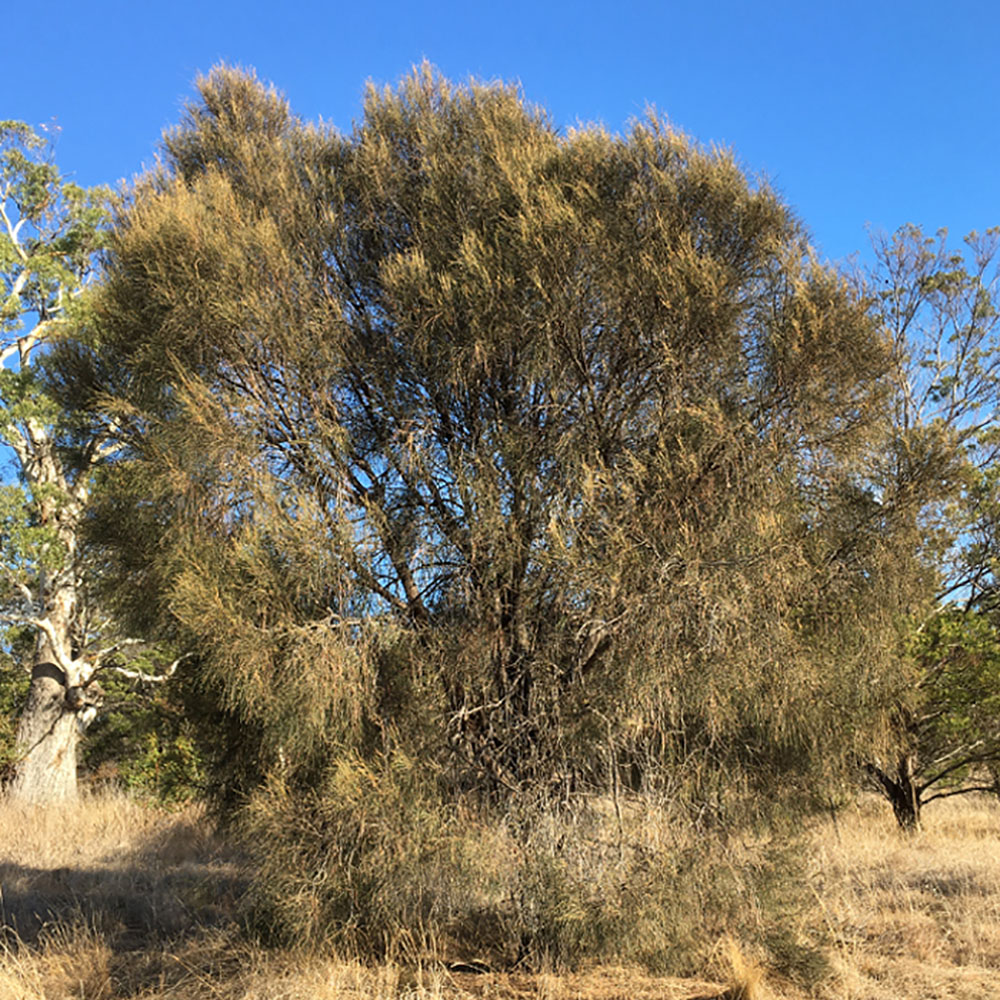
The she-oak is a tree of medium size and irregular form. Other casuarina species might be taller, shorter, or more erect in habit, but they all share needle-like foliage. Their unconventional grey-green foliage shuns excess water and nutrients; it is opportunistic and adaptable.
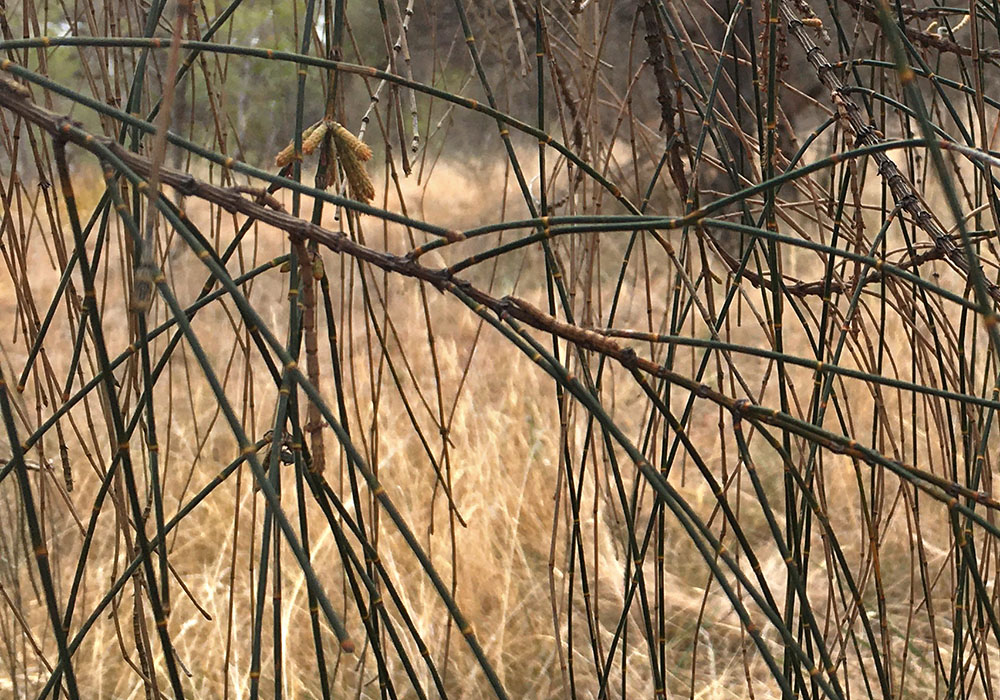
On the eve of the first felling, just a few years ago, signs appeared across the Domain, explaining that the purpose for the casuarina cull was, in fact, ecological restoration of the grassy woodland. A thinning was being carried out of trees that inhibited the sun-loving and fire-appreciative native grassland.
The means of achieving this kind of thinning are varied. They include chainsawing, hand-pulling, mechanical ripping, and the application of herbicide to cut stems. Periodic burns and planting then encourage competition. Hobart City Council’s Fire and Biodiversity team are leading this restoration, in one of their many ongoing projects aimed at enhancing the natural values of diverse land parcels and waterways inside municipal boundaries.
There has been some external funding for the Domain. More importantly, though, there has also been guidance—from Distinguished Professor Jamie Kirkpatrick, a geographer and conservation ecologist at the University of Tasmania. Over several decades, starting in 1974, he has observed the incursion of casuarinas at the cost of the grassland.
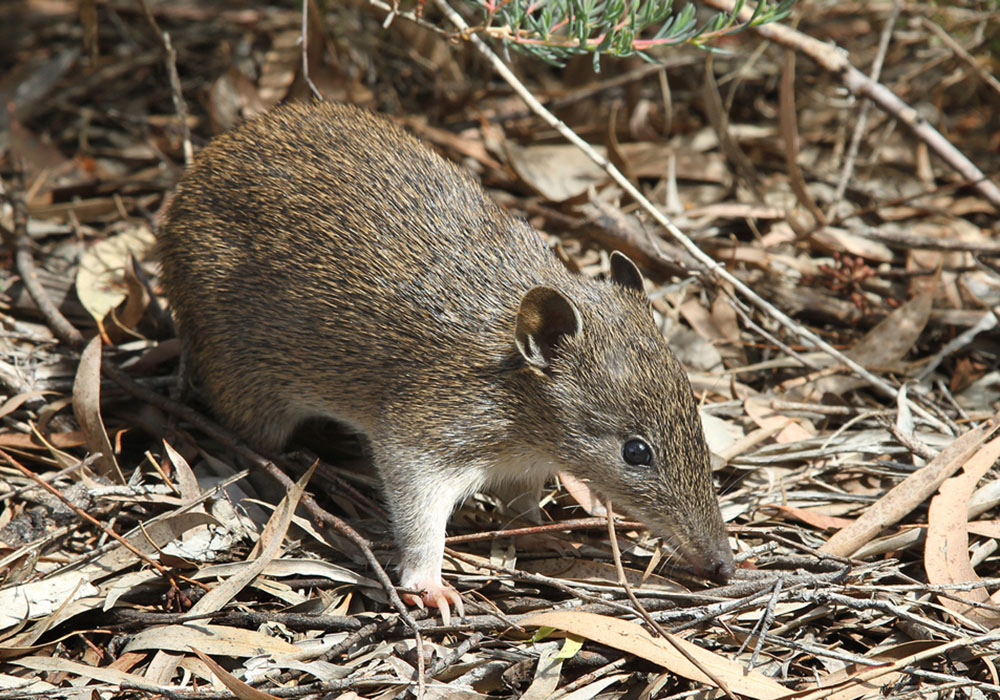
More an overarching objective than being based on a detailed plan, the casuarina cull has evolved as part of an increased commitment to the natural environment across the bushland reserves of Hobart. I am delighted that the Domain grasslands are being recognized as deserving of careful management. Already, anecdotally at least, it is evident that grazing mammals are better supported, with their numbers increasing, and that components of the grassland are diversifying. Bandicoots (southern brown and eastern barred), bettongs, wallabies, and potoroos are not difficult to see. Birdlife is more varied still. Brown quail is one of the more enigmatic species.
However, there is a caveat to this undeniable early success: context is crucial. Recognising the virtues—ecological and cultural—of the casuarina, as much as the problems it creates, is critical to the long-term success of this rewilding project.
The Domain is treasured urban bushland with a complex history of landscape transition. The notion of benchmarking against an idealized pre-settler vegetation underestimates ecological dynamism, before, during, and after indigenous management.
Tree removal, I believe, needs to be strategic. Casuarinas of considerable age and character have been felled. So have ones forming architectural glades, and ones bordering popular recreational tracks. Casuarinas on the Domain shield walkers and joggers from extremes of temperature, from prevailing wind, and from heavy traffic noise. They trap rubbish and weed seed on the borderlands, and they arrest soil movement on steep embankments. Furthermore, casuarinas are connected, through their nitrogen fixing roots, to the living fabric of the planet and to myriad creatures above ground, including us, linking earth and sky in a complex embrace we know so little about.
The culling here, then, is no straightforward matter. The details of which and where and how require considered consultative planning. With the project in its early stages now, there is room for refinement and for mutual coexistence. Despite these concerns, it is clear that a concerted effort to restore and rewild the Domain’s grassy woodland is bringing new life. It is a joy to walk in the fading light amongst grazing marsupials with deep connection to this place.
 Rewilding Successes