

You are welcome to republish this story through the Creative Commons license CC BY-NC-SA 4.0. Where republishing conditions differ for images, this is noted in individual captions. (See this page for more information.)
By Linda Heron
Linda is Chair of the Ontario Rivers Alliance.
Ontario is littered with hundreds of old and decaying concrete, log, and earthen millpond dams, hydropower dams, control dams and diversion dams that have blocked stream flow and filled with sediment over the last 100 years or more.
There is a myriad of reasons for removing dams from freshwater streams, but the most compelling of all is to expand fish habitat and restore the health and natural resilience of riverine ecosystems.
A warming climate
A dam disrupts the natural flow of a stream, establishing a reservoir where water currents are impeded and sediments are trapped. As ambient air temperatures rise, so do stream temperatures, leading to degraded water quality. On the hottest days of summer, the combination of algae and stagnant water creates an unhealthy and toxic environment for aquatic life.
The reservoirs of these aging dams often harbour a significant amount of sediment and rotting litter, turning them into methane factories. Within these reservoirs, methane is produced by bacteria thriving in oxygen-starved environments. These microbes derive energy from organic carbon found in biomass accumulating in the sediment, much like how humans and other animals use organic matter for energy. However, instead of breathing out carbon dioxide, they breathe out methane. Methane is a potent greenhouse gas with a heat-trapping capacity 28–34 times greater than carbon dioxide over a 100-year time scale, and measured over a 20-year period, this ratio grows to 84–86 times.
Conversely, a thriving riverine ecosystem acts as a carbon sink, enhancing its resilience to a warming climate. Consequently, the removal of defunct dams not only improves water quality and increases stream resilience but also quickly transforms a methane-emitting reservoir into a vital carbon sink.
Dam owner liability issues
Climate change is amplifying threats to dam safety as the warming climate leads to more frequent and intense extreme rain events. Dams, once seen as assets, are becoming a precarious liability to dam owners when they can pose a serious risk to both life and property in the event of failure.
Headlines frequently recount tragic events where dams have failed during extreme rain events, resulting in people, homes, vehicles, and infrastructure being washed away with devastating loss of life and property. In contrast, during periods of drought, headlines report on rivers and reservoirs around the globe drying up.
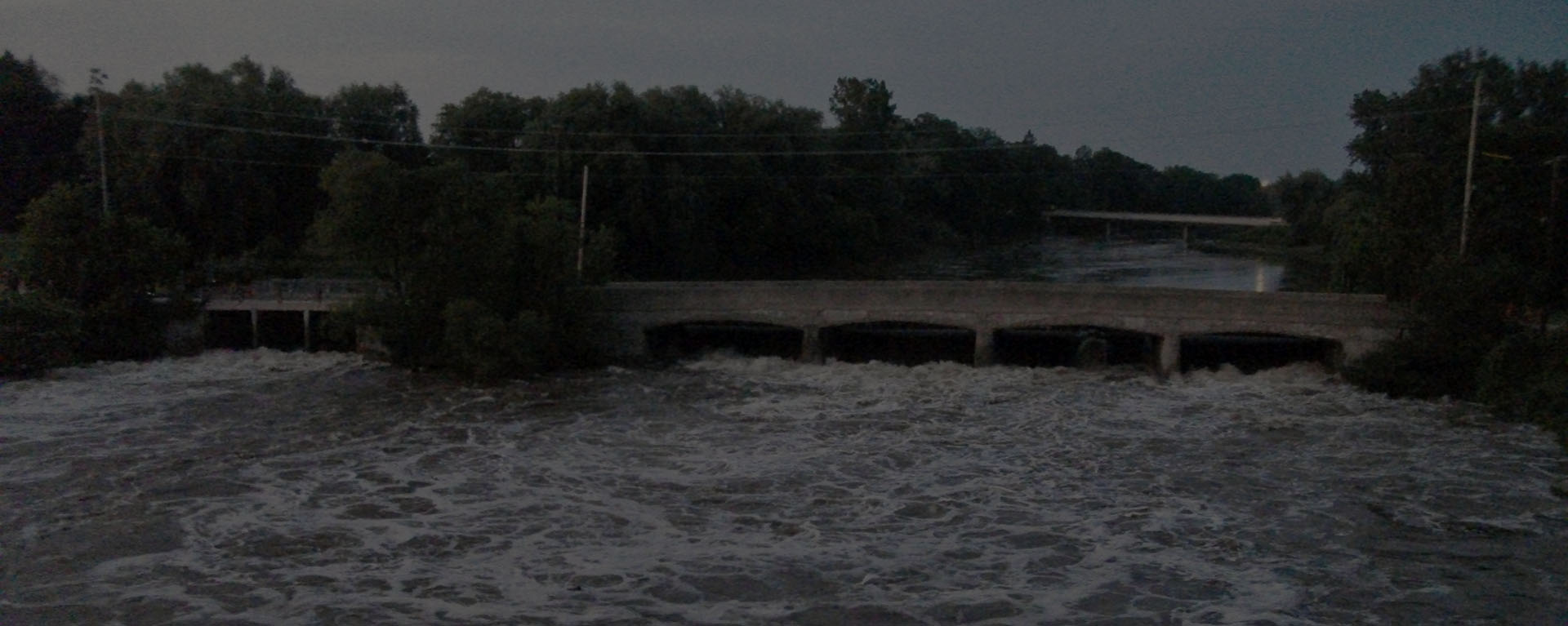
The Gorrie Dam and the Howson Dam on the North Maitland River both failed in June of 2017 during a heavy rain and flood event. The Gorrie Dam was totally destroyed in the storm and, although the Howson Dam was shuddering at full capacity, it only partially failed when the stop logs could not be removed. Fortunately, the dam’s main structure remained in place.

In 2018 the Ontario Rivers Alliance made submissions to the North Maitland Conservation Authority and Huron County Council (also delegated to the County) for the removal of both dams. The Gorrie Dam was removed in 2021, and that same year Huron Council voted to decommission the Howson Dam. It is awaiting permits for removal in 2024.
Part two of this story can be found here.
 Rewilding Successes
One thought on “Dam removal for climate and nature [Eastern Canada] – part one”
Comments are closed.