

You are welcome to republish this story through the Creative Commons license CC BY-NC-SA 4.0. Where republishing conditions differ for images, this is noted in individual captions. (See this page for more information.)
By Sally Zaino
Sally is a writer and poet based in Pennsylvania. She is also a board member of Manada Conservancy, whose various projects include work to support Swatara Creek.
Connecting the Susquehanna River to the Schuylkill River with a canal was William Penn’s idea, before 1700—but construction was not begun for another hundred years. The canal was to be known as the “Golden Link”. However, construction suffered many stops and starts, while engineers struggled to create a canal that, from west to east, would rise 92 feet and fall 311 feet, that was prone to sinkholes, and that lacked a water supply where it crossed the summit. At that summit, there was need for a tunnel—another challenge.
Finally complete, the Union Canal, as it was named, began to operate in 1828. Following along the winding Swatara Creek, it ran about 82 miles and was the primary highway for barges, moved by mules and poled by men, transporting anthracite coal and loads of lumber, from Middletown to Reading.
But it was finished too late; its life was a short five decades. History was moving on. The Canal was not wide enough. Then, after widening was completed at huge cost, it could not compete with the new railroad from Reading to Harrisburg, and in 1881 it closed for good. But like much human effort, it was abandoned, not erased.
The Swatara Creek, wide enough to be called a river itself, flows from the Appalachian Mountains to its mouth at the broad Susquehanna. The word Swatara, in its original form, means the place where we eat eels. Before the Canal, when the creek’s banks were formed by flow and rock, gravity and land, it was a place of abundance, filled with life and bounded by forest. Native American settlements and stopovers occupied its banks; the people fished its waters and hunted its plentiful wildlife. The stream edges, in some places steep, in others shallow, determined where floodwaters found their path.
But wildness is returning, with little concern for the altered topography. Now, the old canal is only a brambled line in a history book—a human geometry on the landscape, punctuated by long pools and stagnant ponds, stretching like a dotted line along the streamside. It lies between the towpath and the far bank—the old trough sometimes still, sometimes moving, slowly filling with plants, mossy logs, and blowdown branches. Floodwaters, using its channel, have found new paths. In places, a flotilla of small yellow flowers fills it, greeting the spring.
The land remembers the long canal, gauged out, now crossing farms, buried under towns, a memory not yet entirely lost, which once connected two rivers far apart. The Union Canal Tunnel, in Lebanon County, has been restored, and it is now a National Historical Landmark within a hundred-acre park, to be visited and kayaked through, monument to a memory.
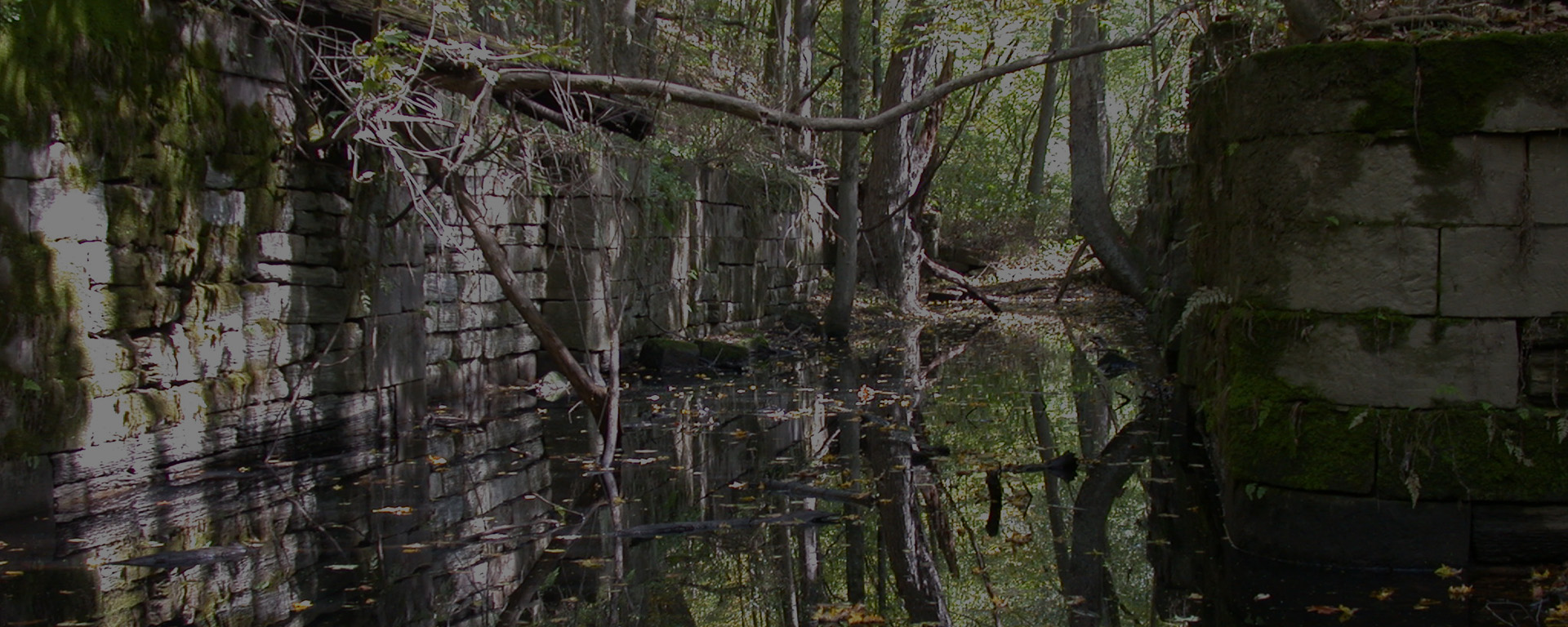
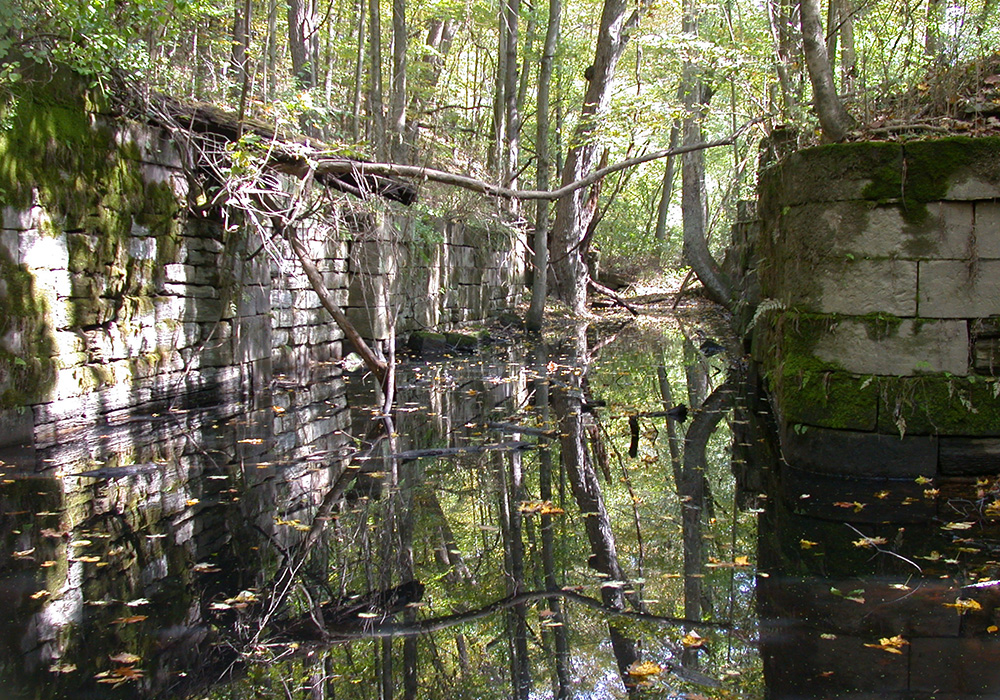
The 93 locks that were constructed can be found as small black dots on old maps. Many of these, and their lockhouses, have been lost to bulldozing, but some still stand, to be discovered only after pushing one’s way through woods and weeds. The forest is taking back its own. What’s left of this long winding waterway is fading, the locks collapsing, their once-imposing walls crumbling, the sun slanting through the trees that have grown between their stones.
Between the Tunnel and the Susquehanna, the geography now answers to a different commerce: of sycamore, of river birch, of water and wind, of wood ducks and turtles, of deer, possum, and raccoon. And to that other set of engineers, the beavers, who have harnessed the creek-flow for their needs.
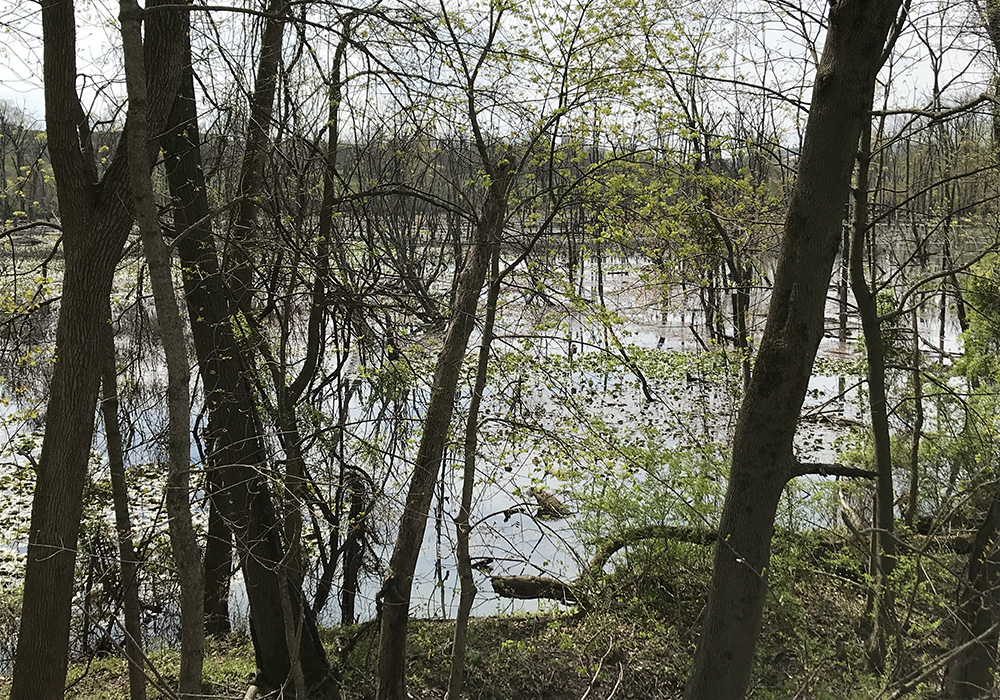
Now dammed, a shallow lake of snags calls to the herons, who have accepted the invitation. A high-rise rookery, silhouetted against the gray sky, is home to squawks and long-legged intent. American eels, once blocked by dams, are now restored to their natural home; the Swatara can be again the place where we eat eels. New wetlands, with protruding beaver lodges, prothonotary warblers, and hidden turtles, replace a once-dry field, which in one place separated towpath from canal. An eagle’s nest nearby is a larger clot of sticks against the sky, overlooking what was once home to the shouts and the bustle of passage.
You can still walk the old towpath, just inches above the water, sun reflecting off the long mercurial channel on one side, and on a mirror lake on the other. Picking your way through briar and sapling, you can almost walk on water, moving in time, meeting the ghosts of those mules and men with poles. Remembering what seemed then so permanent, so much a path to destiny, you see instead the tracks of deer, the splayed footprint of a heron.
 Rewilding Successes