

You are welcome to republish this story through the Creative Commons license CC BY-NC-SA 4.0. Where republishing conditions differ for images, this is noted in individual captions. (See this page for more information.)
By Joe Gray
Joe is editor-in-chief of Rewilding Successes.
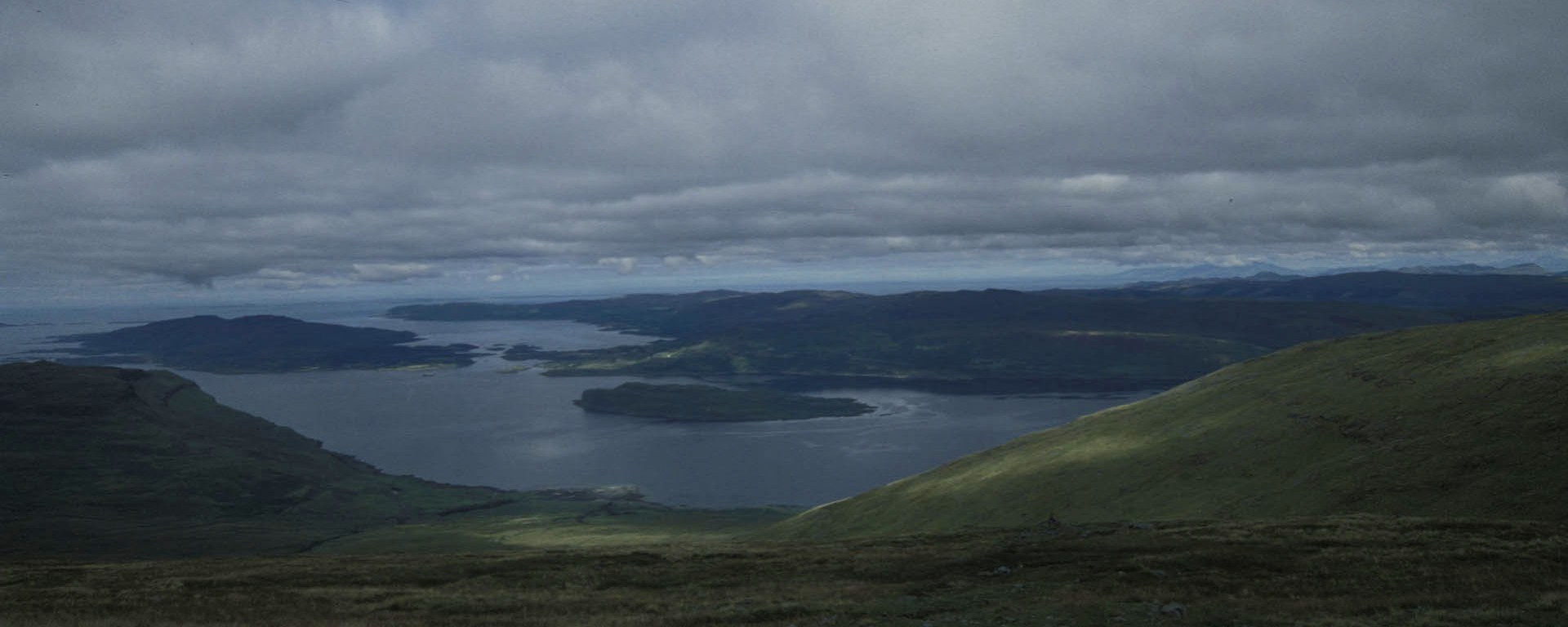
There are patterns in life that recur at different scales. Take the shape of a stretch of rocky coastline, like that found in western Scotland. The kayaker bobbing along a short section of this sees rugged corners and sweeping curves that are repeated—on a larger scale—for a viewer up in the sky.
For our aerial spectator in this comparison, let us choose an eagle—that bird of famed acuity. Actually, let us be more precise than that, if we are talking of Scotland, for the country no longer has just one species of this kind. For most of the twentieth century, the golden eagle soared alone in Scottish skies. But thanks to the tireless efforts of a multi-national team of conservationists, this huge graceful raptor has been joined once again by the equally spectacular white-tailed eagle (a bird also known as the sea eagle, or by the scientific name Haliaeetus albicilla).
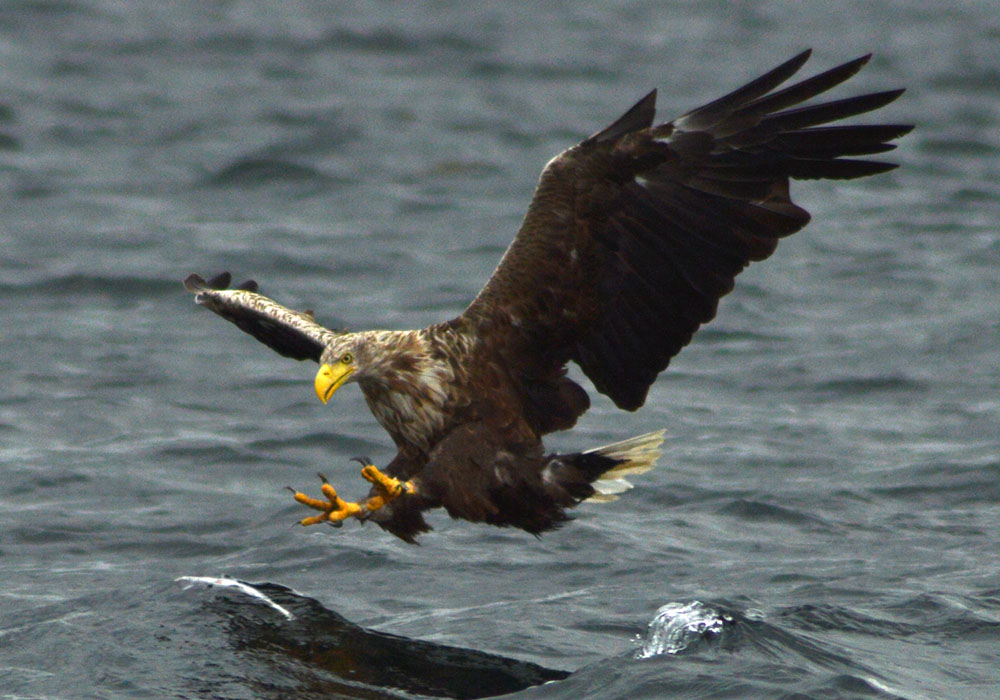
Changing habitat coupled with unwavering persecution had driven the white-tailed eagle to extinction in Britain by the early 1900s. The last known bird from the once-robust native population was shot in Scotland in the final year of World War I.
While this eagle suffered similar pressures in much of the species’ European range, populations in Norway remained sufficiently strong to support translocations. Therefore, when a government project pioneered by the conservationist Roy Dennis sought to reintroduce this lost species, young birds were ‘donated’ from Norwegian nests and flown across the North Sea to be released on the Scottish island of Rum. Between 1975 and 1985, 82 birds were introduced in this way. In a second phase of translocations, which ran from 1993 to 1998, a further 58 individuals were brought across to western Scotland. Then, between 2007 and 2012, 85 more birds were translocated, but this time to the east coast.
Despite there being some significant barriers to success for the project, including the thieving of eggs and shooting of adult birds by humans, along with concerns in the farming community, Scotland’s white-tailed eagle population, today, has comfortably passed 100 territorial pairs. And these breeding birds are now mostly Scottish-born.
In the early years, it should be said, population growth was slow. This was a result, in part, of white-tailed eagles not being ready to breed until they reach five or six years of age. And compounding this delay to maturity was the limited reproductive success enjoyed by novice breeders. It is thought that only with greater experience are these birds able to fledge young in sufficient numbers to drive population growth.
In spite of the slow start, modelling suggests that the population should soon reach 200 pairs and may grow towards 1000 pairs in another couple of decades. Those in the know are talking, for now at least, of exponential growth. And I recently heard someone close to the project speaking of a critical mass having been reached. This was a term that prompted me to take a step back—or, rather, to take flight and soar above the metaphorical landscape of rewilding.
For patterns, as I noted at the start, can repeat themselves at different scales. In the case of the white-tailed eagle’s reintroduction to Scotland, significant obstacles had to be overcome, growth was slow early on, and the rewilders had to be patient, but in time a ‘critical mass’ was reached and the species’ population became self-supporting. In the case of rewilding, looking at the larger scale, I would like to think that despite early obstacles and the necessarily unhurried progress towards success of individual projects—after all, each one is drawing on nature’s own heartbeat—we are now beginning to reach a stage where the movement will start growing exponentially under its own steam.
Or let me put it another way: I believe that rewilding successes are starting to become contagious.
 Rewilding Successes